The supplier quality record,
captured at the source.
SQOS captures containment, counts, and conformance straight from the systems you already run, so the record is proof, not reconstruction.
FOR SUPPLIER QUALITY ENGINEERS & THE LEADERS WHO ANSWER FOR THE NUMBERS
From qualification to proof, on a single record.
The work moves through three stages — plan and qualify, detect and resolve, then prove it — and SQOS keeps all three on one record, captured from the systems you already run. Previews below, shown with representative data.
Qualify the part before it reaches the line.
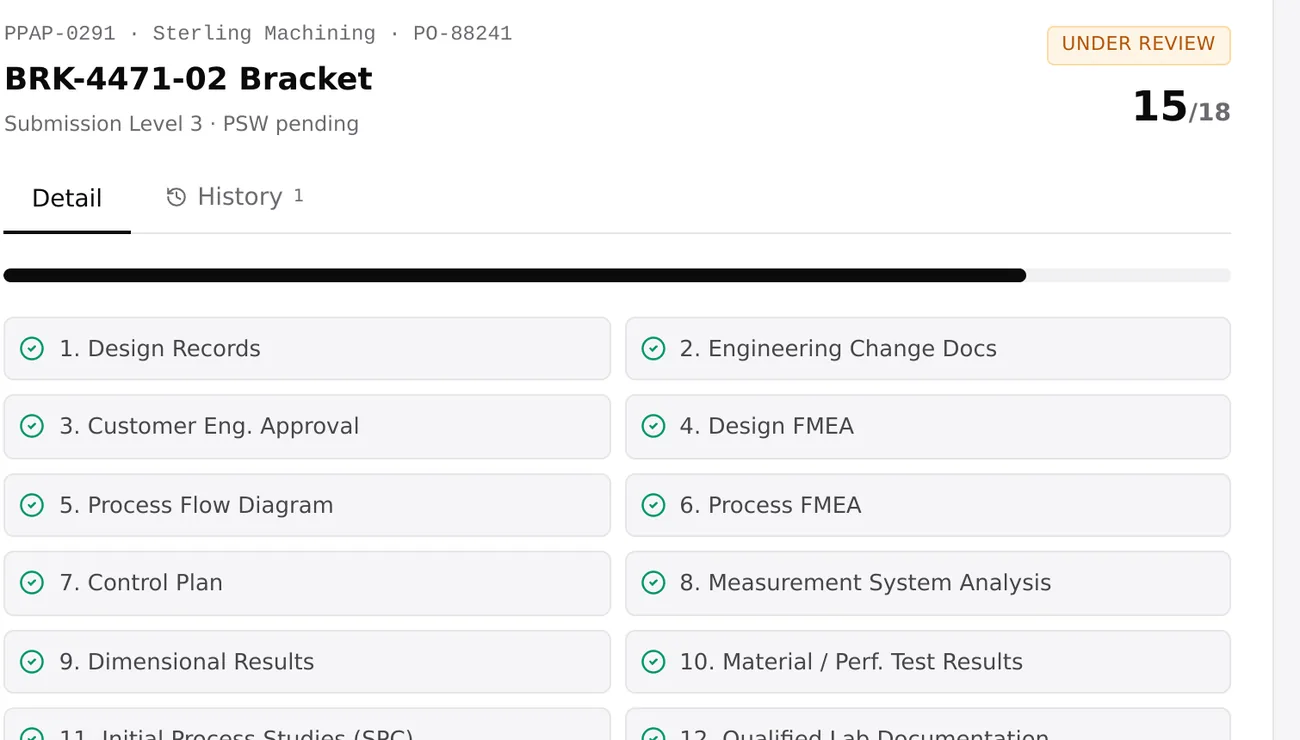
APQP and NPI gates, the full PPAP element package, first-article inspection, and the plans that route every characteristic. Approvals live on the record, not in an inbox.
Catch it, contain it, close it.
Nonconformances captured where they happen, escalated to SCAR with the 8D inside the ticket, deviations dispositioned through MRB. Aging is visible long before it turns into a past-due problem.

Prove it in the numbers.
First-pass yield, PPM, and cost of poor quality, computed from inspection lots and reconciled to containment. The open-versus-closed picture is one you can stand behind in a review.

You can’t forecast a nonconformance.
Purchasing and supply planning run on forecasts. Supplier quality runs on what just went wrong, a nonconformance that can surface at any stage and has to be resolved fast, with the whole record already in hand. A portal collects information; it was never built to run that work.
A place to submit information.
- Suppliers log in. Documents get uploaded. Forms get submitted.
- Someone still chases updates by email and reconciles the truth by hand.
- Containment lives in a separate spreadsheet. Counts are whatever was typed.
- The scorecard is a monthly export that's stale the day it's sent.
A system that runs the operation.
- Containment lives inside the SCAR, tied to the part, lot, and disposition.
- Counts come straight from WMS and MES through the API.
- Every event posts to scorecards and chargebacks as it happens.
- The record stays current because the system keeps it current.
Quality events are dollars. SQOS makes them recoverable.
When a containment, a chargeback, or a nonconformance is captured as a transaction instead of a conversation, the cost stops disappearing. Supply chain and quality leaders get one current view of liability, recovery, and supplier performance, the number they actually answer for.
The questions buyers actually ask.
How is this different from the supplier portal we already have?+
How deep does the integration actually go?+
What does it cost?+
See it run on your suppliers.
A working demo, not slides. Bring a real supplier scenario and we'll walk the operating system end to end, from containment to recovery.
FOR SUPPLIER QUALITY ENGINEERS & THE LEADERS WHO OWN THE METRICS